
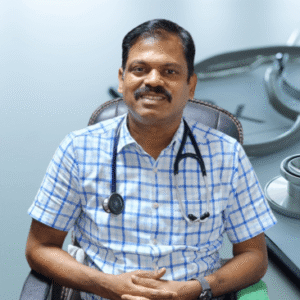

Written by P. Deepika, Content Writer, Healthcare Industry. Medically reviewed by: [Dr. T. Viswanathan, MBBS, Managing Director and Chief Doctor, Kanaga Hospitals]. Last medically reviewed: [22-10-2026]. Choose a multispeciality hospital that treats your condition regularly, is verifiably accredited, has a 24-hour emergency department, employs registered doctors, gives clear written cost estimates, and is close enough to reach quickly. The checklist below turns that into ten questions you can ask before you commit. Most families don’t really choose a hospital. They end up at one. It usually happens at 2 a.m., with a worried relative beside you and a phone in your hand, which is the worst possible moment to compare options, check credentials or ask about costs. So do it now, while things are calm. I’m Dr. T. Viswanathan, and after 32 years in general medicine I can tell you that the families who cope best in a medical emergency are usually the ones who already knew where they would go, who they would call and what they would be asked to pay. This guide gives you the questions I would ask if I were choosing for my own family. Save it on your phone and share it with the people you live with.
At a glance: five things you can verify in ten minutes
- Accreditation: search the hospital on the official NABH site, and check the lab on the NABL site.
- Doctors: look up the consultant’s name in the National Medical Register.
- Emergency: call after 10 p.m. and ask if a doctor is in casualty right now.
- Cost: ask for a written estimate before admission.
- Insurance: check your insurer’s network list for the hospital by name.
Table of contents
- Quick Checklist (Save or Screenshot This)
- The 10-Point Checklist
- Match the Hospital to Your Medical Need
- Check Accreditation and Verify It Yourself
- Confirm Real 24×7 Emergency Care
- Verify the Doctors
- Look at Diagnostics and Technology
- Understand Insurance and Costs Before Admission
- Consider Location and Access
- Read Patient Reviews Carefully
- Check Communication, Consent and Privacy
- Ask About Follow-up and Continuity of Care
- Red Flags to Watch For
- What to Expect at Kanaga Hospitals
- Conclusion
- Frequently Asked Questions
- Sources and Medical Disclaimer
Quick checklist
| S.No | Ask or Check | Where to Verify |
| 1 | Does the hospital treat my condition regularly? | Hospital website, doctor list, or helpdesk |
| 2 | Is it NABH-accredited? Is the lab NABL-accredited? | Official NABH and NABL websites |
| 3 | Is emergency care available 24/7 with a doctor on duty? | Call the hospital and ask |
| 4 | Are the doctors registered? | National Medical Register (NMC) |
| 5 | Are diagnostics such as lab tests, X-rays, and ultrasound available on-site? | Hospital website or visit |
| 6 | Is my insurer or TPA included in the hospital network? | Insurer’s network list or hospital billing desk |
| 7 | Will I receive a written cost estimate? | Ask before admission |
| 8 | Can I reach the hospital quickly from home or work? | Maps and route planning |
| 9 | What do recent patients say about the hospital? | Google Maps, Practo and Justdial reviews |
| 10 | Is follow-up care available, including physiotherapy and review visits? | Ask the doctor |
The 10-point checklist
1. Match the hospital to your medical need
Start with why you need care. A hospital that performs hundreds of joint replacements a year is a better fit for knee pain than one that mainly handles maternity. Write down your main condition, any chronic illnesses (such as diabetes or hypertension), and which family members will use the hospital. Then check whether the hospital has the relevant departments and the specialists, not just a department name on a board. A multispeciality hospital makes sense if you have more than one condition, need tests and consultations in the same place, or want one set of records across specialities. For example, if you are managing diabetes and have started getting knee pain, it helps when the diabetes doctor and the orthopaedic surgeon can see the same reports under one roof. If you are planning for a baby, look for a hospital where obstetrics and paediatrics work together. Ask the helpdesk: Which doctor will treat me, and on which days are they in? Some specialists visit only once or twice a week, so confirm the days and timings before you travel.
2. Check accreditation, and verify it yourself
Accreditation shows a hospital follows set standards for patient safety and quality. In India, look for:
- NABH accreditation for the hospital
- NABL accreditation for the laboratory
- JCI is an international accreditation and is less common among smaller hospitals
Don’t rely on a logo on a banner. Check the accreditation body’s own listing, and note whether it is current, since accreditations expire. A hospital that is not accredited can still provide good care, so treat accreditation as one signal among several, not the only one. One detail that trips people up: NABH also offers an entry-level certification for smaller hospitals, which is different from full accreditation. If a hospital says “NABH”, ask which one it holds and check the validity date.
3. Confirm real 24×7 emergency care
“24-hour emergency” should mean a doctor on duty at all times, not just a phone line. Call at night and ask: Is a doctor in casualty now? Is there an ambulance? Are X-ray, lab and pharmacy open overnight? Ask how patients needing a higher level of care (such as ICU or specialist surgery) are handled, and whether the hospital transfers patients when needed.
Editorial Note
If it is a true emergency, don’t compare. Go. Chest pain, sudden weakness or slurred speech, severe bleeding, trouble breathing, a serious accident: call 108 (the free ambulance service in Tamil Nadu) or 112 and go to the nearest emergency department. For heart attack and stroke, minutes matter more than brand names. This checklist is for the calm days before that. Save the number of your nearest 24-hour emergency department in your phone today, and teach every adult in the house to use it.
4. Verify the doctors
Every doctor in India must be registered. You can check registration and qualifications on the National Medical Register (NMC) and the Tamil Nadu Medical Council. Look at the hospital’s doctor list for qualifications, specialisation and years of experience. A good hospital makes this information easy to find. A quick decoder: MBBS is the basic medical degree. MD, MS or DNB shows postgraduate training in a speciality, and DM or MCh shows super-speciality training. If a doctor is described as a “specialist”, the qualification should match the speciality. Also notice how doctors communicate. A good doctor explains the diagnosis, the options and the risks in plain language, and welcomes a second opinion. Ask: Who will actually treat me, the consultant or a duty doctor? How often has the team done this procedure?
5. Look at diagnostics and technology
You want tests done quickly under one roof: laboratory, X-ray, ultrasound, ECG/echo, and pharmacy. Having these on site means less travel and faster results. Ask what equipment is available for your condition, rather than looking for the word “advanced”. If you can, visit and check that the wards, waiting areas and washrooms are clean and well organised. Ask which tests are done in-house, which are “on call” and which are sent outside, and how long reports take. Also ask whether reports are shared digitally so you can show them to another doctor without chasing paper copies. Check for in-house services such as the laboratory, X-ray and ultrasonography and echo.
6. Understand insurance and costs before admission
- Ask whether your insurer or TPA has a tie-up with the hospital, and whether cashless treatment applies to your plan.
- For planned treatment, ask for pre-authorisation a few days ahead and keep your policy number and ID ready.
- Ask for a written estimate covering room, procedure, medicines, tests and doctor fees, and ask what could change the final bill.
- If cashless isn’t available, ask what documents you’ll need for reimbursement.
Insurance rules differ by plan, so always confirm with your insurer and the hospital billing desk. A few things worth knowing before you sign anything:
- Read your policy for room-rent limits, co-payment and sub-limits. These are the usual reasons a “cashless” bill still leaves you paying.
- Know your timelines. Under the IRDAI master circular on health insurance (May 2024), insurers are expected to decide a cashless request within one hour and give final authorisation at discharge within three hours of the hospital’s request. If you are kept waiting well beyond that, ask the billing desk to escalate with the insurer or TPA. Rules can change, so check the current IRDAI guidance.
Ask about government schemes. If you are covered under Tamil Nadu’s Chief Minister’s Comprehensive Health Insurance Scheme (CMCHIS), ask whether the hospital is empanelled for your treatment. Carry with you: insurance card, photo ID, the doctor’s admission note and recent reports.
7. Consider location and access
In an emergency, travel time matters. Check the route from your home and workplace at different times of day, and ask about parking and ambulance access. A hospital that is slightly further away but much better for your condition may still be the right choice for planned care, while for emergencies the nearest 24-hour facility matters most. Do a trial run on a quiet Sunday if you can. Save the hospital’s map pin and phone number in your phone now, and note how the route behaves at night and in peak traffic. Ask whether the hospital can arrange an ambulance.
8. Read patient reviews carefully
Check Google Maps reviews first, then Practo and Justdial. Look for patterns rather than single stories: staff behaviour, waiting time, billing clarity, cleanliness, and how complaints were handled. A few negative reviews are normal. Pay attention to how the hospital responds to them. Read the three-star reviews. They tend to be the most balanced. Check the dates, because a review from five years ago says little about today. Be wary of a burst of near-identical five-star reviews. And if you leave a review yourself, please keep medical details private.
9. Check communication, consent and privacy
Good hospitals explain the treatment plan, ask for your informed consent before procedures, protect your medical records, and respect your decision to seek a second opinion. You should be able to ask questions without feeling rushed. You are entitled to understand your treatment, to see an itemised bill and to ask for copies of your reports and discharge summary. India’s Charter of Patients’ Rights, drafted by the National Human Rights Commission, sets this out. Ask how your records are stored and who can see them.
10. Ask about follow-up and continuity of care
Recovery doesn’t end at discharge. Ask whether follow-up visits, physiotherapy, lab monitoring and pharmacy support are available in the same place, and whether your records stay in one system. Before you leave, make sure you have a discharge summary, a medicine list in plain language, the date of your next review, and a number to call if symptoms get worse at night.
Red flags to watch for
- No clear information about doctors’ qualifications
- Reluctance to give a written estimate
- Pressure to choose expensive options without explanation
- No emergency doctor on duty after hours
- Unclear answers about accreditation or insurance
- Promises of a guaranteed cure or a “100% success rate”
- Pressure to decide on non-emergency surgery the same day
- Unwillingness to explain or itemise the bill
- Crowded, unclean wards or visible lapses in hand hygiene
What to expect at Kanaga Hospitals
Kanaga Hospitals in Kovur, Mangadu serves patients from Mangadu, Kundrathur, Porur and nearby areas. We would rather you ask us the same questions you would ask anyone else, so here are straight answers. Our services include:
- 13 specialities, including General Medicine, Cardiology, Orthopaedic Surgery, Paediatrics, Gynaecology & Obstetrics, Urology, ENT, Dermatology and Dental
- 24-hour casualty, laboratory, pharmacy and X-ray
- Emergency care and physiotherapy
- A 13-member specialist team: meet our doctors
Address: 7-131, Kundrathur Main Rd, Kovur, Mangadu, Chennai 600128 | Phone: +91 9500135319 | Book an appointment: kanagahospitals.com/appointment/ | WhatsApp: +91 9566256975
Frequently asked questions
What is a multispeciality hospital? A hospital with several medical departments, such as medicine, surgery, paediatrics and gynaecology, plus shared diagnostics and emergency care. How do I check if a hospital in Chennai is NABH accredited? Search the hospital’s name on the NABH website (nabh.co) and check that the accreditation is current. How can I verify a doctor’s registration? Use the National Medical Register on the NMC website, or check with the Tamil Nadu Medical Council. Is a multispeciality hospital better than a clinic? For minor, routine problems a clinic is often enough. A multispeciality hospital is better when you need tests, specialists, procedures or emergency care in one place. Do multispeciality hospitals accept insurance? Many have cashless tie-ups with insurers and TPAs, but it depends on your plan. Confirm with your insurer and the hospital billing desk before admission. What should I ask before planned surgery? Ask about the surgeon’s experience with the procedure, the risks and alternatives, the total estimated cost, the expected stay, and follow-up care. What is the nearest 24-hour hospital in Mangadu or Kundrathur? Kanaga Hospitals in Kovur, Mangadu offers 24-hour casualty, lab, pharmacy and X-ray. Should I get a second opinion? Yes, especially before surgery or a long treatment. A good hospital will support this. What is the difference between a multispeciality and a super-speciality hospital? A multispeciality hospital covers many common specialities, such as medicine, surgery, paediatrics and obstetrics. A super-speciality hospital focuses on advanced fields like cardiac surgery, neurosurgery or transplants, usually with DM or MCh-trained doctors. Many families start at a multispeciality hospital and are referred onward if needed. What documents should I carry for hospital admission? Photo ID, insurance card or policy number, the doctor’s admission note, previous reports and prescriptions, and a list of current medicines and allergies. How do I find out if a hospital offers cashless treatment for my policy? Check the network hospital list on your insurer’s website or app, then call the hospital’s billing desk with your policy number to confirm. Do this before a planned admission. Can I change hospitals in the middle of treatment? Yes. Ask for your discharge summary, reports and medicine list, and tell your new doctor what has been done so far. If you are in an emergency, move only when a doctor says the transfer is safe.
Conclusion
The best hospital for you is the one that fits your condition, can be verified, treats emergencies at any hour, communicates clearly about cost and care, and is easy to reach. Use the checklist above, ask direct questions, and visit if you can. If you would like to see our facilities or speak to a doctor, book an appointment or call +91 9500135319. Comparing options across the city? Our guide to the top multispeciality hospitals in Chennai walks through the main choices side by side. And whatever you decide, save the checklist and share it with your family. You will be glad you did. Disclaimer: This article is general information to help you choose a hospital. It is not a substitute for personal medical advice, diagnosis or treatment. In an emergency, call 108 or 112 or go to the nearest emergency department.
Need Help Choosing? Talk to Us
If you are still unsure which hospital suits your condition, our team will happily talk it through. Contact Kanaga Hospitals for assistance or book an appointment with our team.
Need Emergency Medical Care?
For a medical emergency in India, call 108 or visit our Emergency Care Department.


